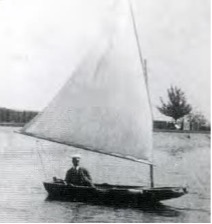
The origin of all the varieties of Scow sailing dinghy found on the shores of the Solent is the Plymouth Sound Pram dinghy. A Captain H H Nicholson of Lymington acquired a Plymouth Sound Pram in 1905 and sailed her on the Lymington River and in the Western Solent, however she was found not to fare well with the Solent chop, as the blunt bow would cause her to lose speed. In 1912 he commissioned Lymington boatbuilder Dan Bran to build a more seaworthy version with a sharper bow; this design was developed to become the Lymington Scow.
The Cruising Association reported in 1913 that the new design “shows a very good turn of speed and is much admired”.
Captain Nicholson founded the Lymington River Sailing Club, which later became the Royal Lymington Sailing Club. By 1914 the club had a fleet of 13 Lymington scows with regular scow class racing. Production ceased in 1914 due to the first world war, but after the war interest in scow sailing and construction resumed.
In 1921 the Berthon Boat Company was advertising a Lymington Scow complete for £40. Yachting Monthly reported it had ‘standardised the model and designed elaborate jigs so that all parts may be machined and prepared for erection’.

The standard boat was planked with wych elm and larch, with pine thwarts. The iron fittings were galvanized. There was also a model ‘de luxe‘ in mahogany with gun metal fittings at £10 more. By 1948 Berthon had produced over 200. By 1948 Berthon had produced over 200.
In 1923, Herbert Reynolds and Dr Drummond, of Yarmouth, Isle of Wight, both devotees of the Lymington Scow, decided to build a modified version more suited to the waters of the Yar and the strong tides outside Yarmouth. After consultation on the design, including input from renowned yacht designer Uffa Fox, Yarmouth boat builders Theo Smith and Bernard Hayward were commissioned to build two dinghies. This modified design became the West Wight Scow.

The West Wight Scow rapidly became popular and soon attracted supporters. The West Wight Sailing Club was founded in Yarmouth in the old Customs House and adjacent cottages, on the site of what is now the Yarmouth ferry terminal. In the 1920’s and 30’s there were up to 50 West Wight Scows in the annual Yarmouth Regatta.
In 1945 the West Wight Sailing Club amalgamated with the Royal Solent Yacht Club. With the number of West Wight Scows increasing in 1948 it was decided to form the West Wight Scow Class Association to take ownership of the class, enable clubs to run divisions or fleets and other builders to be appointed.
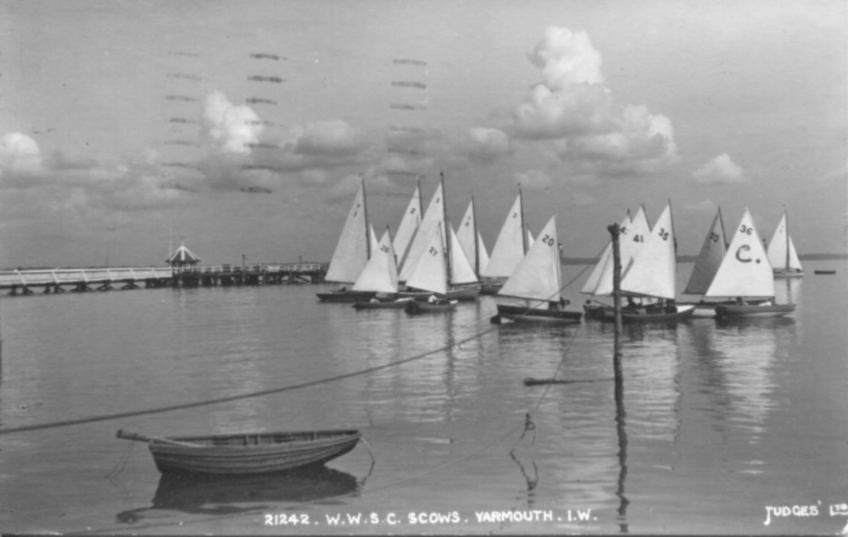
Following the second world war the Island Sailing Club at Cowes adopted the class, but made a slight alteration to the shape, creating what was termed the Solent Scow. In 1950 the Solent Scow design was adopted by both the Bembridge Sailing Dinghy Club (BSDC) and Bembridge Haven Yacht Club, following the BSDC captain seeing them in action on the choppy waters off Cowes.
The Solent Scow also became known as the Bembridge Scow, with local boatbuilders such as Alan Coombes producing some 200 dinghies.

The Solent Scow also became known as the Bembridge Scow, with local boatbuilders such as Alan Coombes producing some 200 dinghies.
In the 1960’s and 70’s saw many changes to the dinghy fleets around the Solent, with new designs, such as the Mirror Dinghy, becoming available.
With changes in technology most boatbuilders moved from traditional wooden construction to glass reenforced plastic (GRP).
The changes bought a renewed interest in all types of dinghy sailing with the various scow classes remaining highly popular as it is enjoyable to sail and easy to handle both on land and on the water. Scows are sailed and raced competitively by at clubs across the Isle of Wight and on the mainland, with large fleets at locations such as Keyhaven, Lymington, Beaulieu, Porchester and Chichester.
As they require less maintenance the majority of boats sailed today are GRP, however with the increasing interest in traditional boatbuilding and classic wooden boats of all types there has been a resurgence of the wooden scow. Surviving wooden boats being restored and a new generation of boatbuilders are making wooden scows.

 Classic Scows