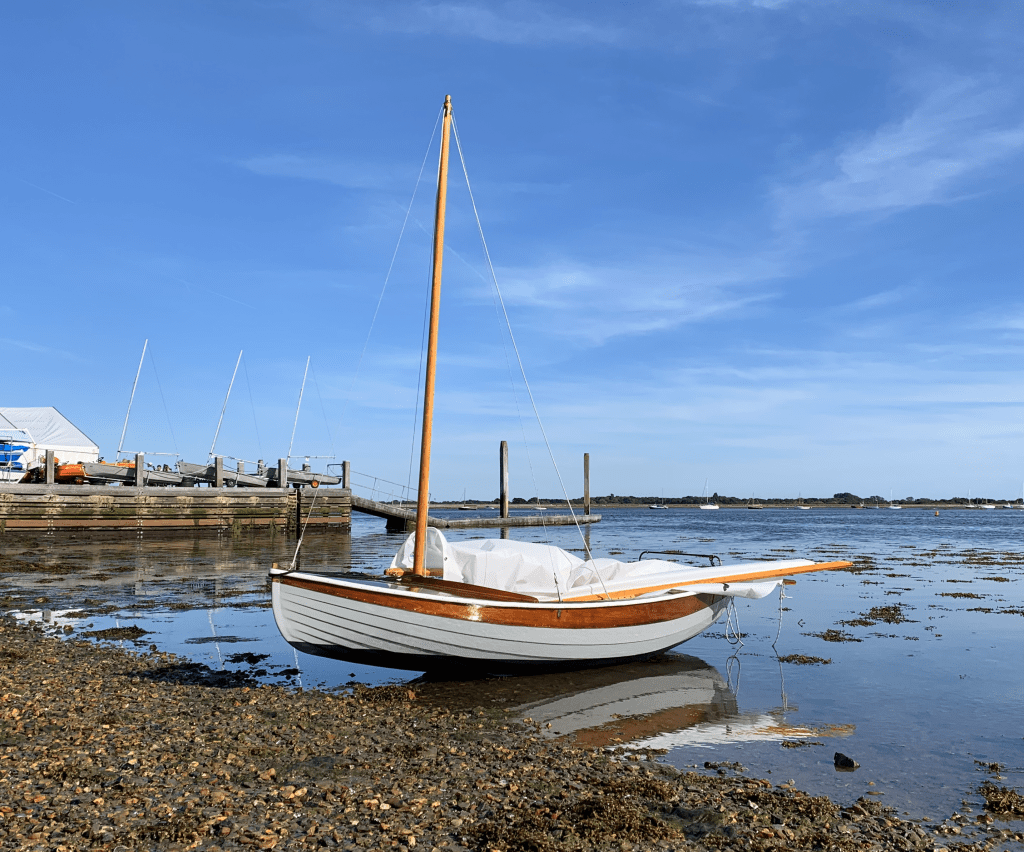
The different Scow classes each have their own sets of rules. The Scow Types page provides links to the rules for each class.
The rules below are for the West Wight Scow Class Association –
- Current Rules – aligned with other Scow fleets to facilitate mixed fleet scow racing & modern sailing needs
- 1952 Rules – The historic rules, which reflect the original aims of the association
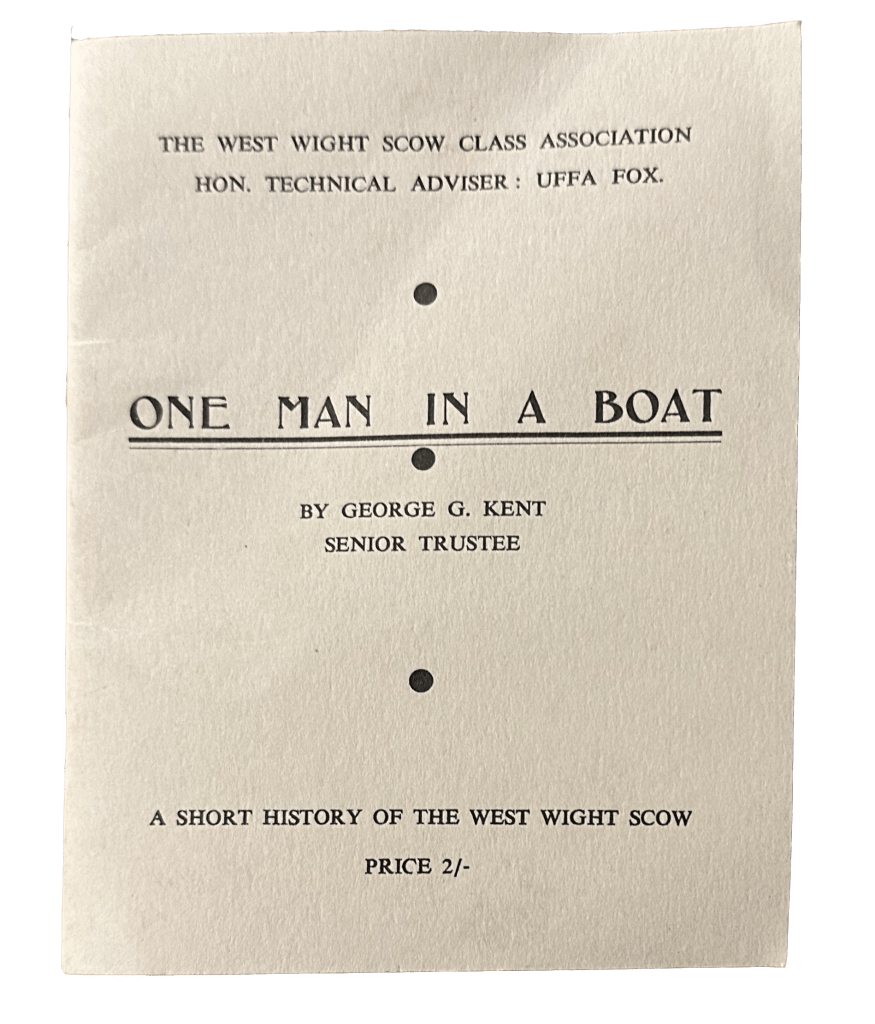
The rules of the West Wight Scow Association were published in 1952 by George Kent, a senior Trustee of the association, in his short book ‘One Man In a Boat’.
This book also included a history of the class,
details of how boatbuilders could obtain plans for the West Wight Scow, a list of the 220 West Wight Scows that had been built by 1952 and racing results for the year.
The 1952 rules provide an insight into the early history of the association and the rise in the popularity of the Scow class. These rules however no longer reflect the needs of sailing today. The 1952 rules have now been superseded and are included here for historical interest.
WEST WIGHT SCOW CLASS ASSOCIATION
1952 RULES
Article 1 – OBJECT
To promote and develop West Wight Scow Class racing at home and abroad under uniform rules and governed by this Association
Article 2 – POLICY
- To cooperate with all other Clubs and Yachting Organisations and to request in return observation of the Rules of the West Wight Scow Class Association
- To form and assist Divisions whenever required
- To keep the West Wight Scow Class Association within the financial reach of those with most modest means.
Article 3 – ORGANISATION
- The individual shall join through a Division in whose waters he normally sails. The power to accept or reject application for membership is vested in the Division
- The Division, a territorial branch or unit, is open to all eligible persons within its territory.
- Each Division shall elect its own Captain and Secretary who shall be known as the Officers of the Division and be self-governing in local matters not conflicting with the Association Rules.
Article 4 – JURISDICTION
The Association has jurisdiction over all West Wight Scow Class activities. Its Class Rules govern all West Wight Scow Class races wherever held. Its Constitution, by-laws and rules are binding upon all members and Divisions (or Fleets) and all West Wight Scow Class boats must conform to its official plans and specifications strictly within the limitations of the measurement rules.
Article 5 – DIVISION CHARTERS
- A new Division may be granted a charter upon application to the Governing Committee by three or more owners, or prospective owners of three West Wight Scow Class yachts not within the locality of an existing Division.
- Charters may be granted by the Governing Committee or suspended or revoked.
Article 6 – SUBSCRIPTIONS
Association subscriptions, if any, shall be fixed by the by-lays. Division subscriptions, if any, by the Division. Both must be paid in advance.
Article 7 – GOVERNING COMMITTEE
The following Association Officers shall be appointed for life, but, should any retire or cease to hold office for any reason, the remainder shall elect replacements. They will appoint a secretaryThe main function of these Officers will be to take charge of social activities and chairmanship of the committee
- Senior Trustee
- Trustee
- Trustee
Article 8 – APPOINTED OFFICERS
A measurement committee to consist of three shall be in charge of all certified measures, grant or reject measurement certificates, collect fees and royalties, sell plans and specifications and answer questions on measurement rules.
BY-LAWS
Article 1 – DIVISION BUSINESS AND MEETINGS
- Business between Association and Division shall be by correspondence.
- An Annual General Meeting of each Division shall be held each year
Article 2 – SUBSCRIPTION
Divisions £2 2s 0d per annum. Due 1st January each year
Article 3 – RENEWAL OF CHARTER
Each Division shall report its activities each January in order to renew its charter.
Article 4 – ELIGIBLE YACHTS
A yacht is considered in the West Wight Scow Class only if it conforms to the measurement rules and had been properly registered.
Article 5 – YACHT NUMBER AND NAME
The official number, allotted to new yachts on application to the association, shall be permanent and fixed to sail and burnt into the boat. A name is optional, but must be recorded.
Article 6 – MEASUREMENT AND CERTIFICATE
- No yacht shall be eligible to enter any race for the West Wight Scow Class Association until a measurement certificate has been granted for such yacht.
- Qualified measurers will be appointed by the Chairman of the Measurement Committee. A fee approved by the Measurement Committee will be charged.
Article 7 – RACING RESTRICTIONS
- Racing Flag Size; 6 1/2″ x 5 1/2″
- Permanent Streamer at Peak
- Class Number Size as for International 14ft Dinghies must be placed on both sides of the sail near the peak with the number on one side higher than the other
- Every boat must have a permit Fend-Off
- No passenger or ballast to be carried when racing. Junior members (18 or under) may have a passenger providing the passenger does not take the helm.
Article 8 – NOTICE TO BUILDERS AND SAILMAKERS
The West Wight Scow Class Association own the sole right, totle and interest on the design of the West Wight Scows.
The Association reserve the right to refuse to issue a number or grant a measurement certificate to any yacht on which the royalty has not been paid or which was not built by a boat builder approved by the Association for a recorded owner or official of the West Wight Scow Class Association.
PLANS – Plans are not transferable. They are sold subject to terms and conditions . Price £2 2s 0d per set.
ROYALTIES – A Royalty of 10/6d, or number tax, must be paid by the builder on each West Wight Scow Class built. A royalty is also required from the sailmaker for each sail made (ie 5% if net invoice price).
Article 9 – RACING FACILITIES
Division should arrange suitable facilities for slipping, scrubbing, storage of sails and moorings.
Article 10 – SCRUBBING
There is no restriction on slipping and scrubbing as there is little or no expense involved. Owners are encouraged to scrub as often as possible.
Article 11 – SAFETY AT SEA
No buoyancy tanks are fitted because West Wight Scows float when filled. For passage races, however, one life jacket for each person on board must be carried. A guard launch of adequate speed should be provided when West Wight Scows are racing in open waters in rough weather.
There is nothing to prevent Divisions from making Local Rules regarding Buoyancy Tanks should they wish to do so, but the West Solent Division have raced for 25 years without them.
 Classic Scows